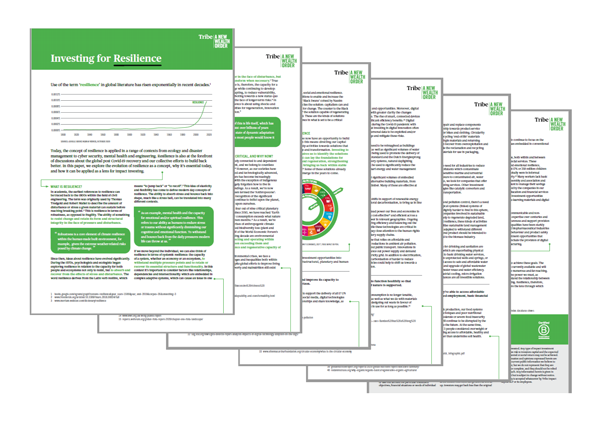


Use of the term ‘resilience’ in global literature has risen exponentially in recent decades.1
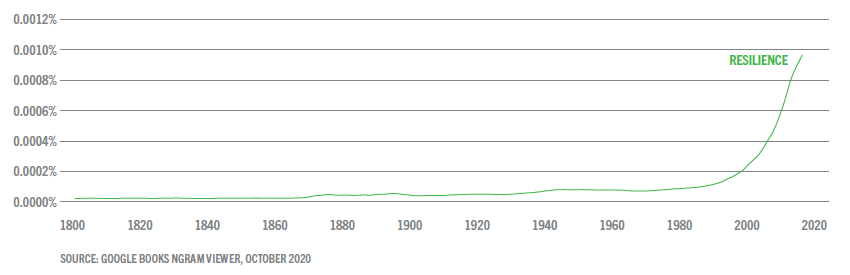
Today, the concept of resilience is applied in a range of contexts from ecology and disaster management to cyber security, mental health and engineering. Resilience is also at the forefront of discussions about the global post Covid-19 recovery and our collective efforts to build back better. In this paper, we explore the evolution of resilience as a concept, why it’s essential today, and how it can be applied as a lens for impact investing.
At Tribe, we focus on many forms of resilience. We divide our range of resilience based investment opportunities into three categories which are integral to facilitating the systems change we want to see: infrastructural, planetary and human resilience:
Infrastructural Resilience: to strengthen our man-made environment and improve its capacity to withstand the various potential social-ecological disruptions on the horizon.
Digital Innovation: Digital technology and software has the unique ability to support the delivery of all 17 UN Sustainable Development Goals (SDGs)UN Sustainable Development Goals (UN SDGs)The Sustainable Development Goals (SDGs), also known as the Global Goals, were adopted by the United Nations in 2015 as a universal call to action to end poverty, protect the planet, and ensure that by 2030 all people enjoy peace and prosperity. There are 17 goals. read more.2 From the internet to smart phones and social media, digital technologies increase our capacity to connect and communicate. They enable us to form relationships and share knowledge, as well as engage with political, educational, healthcare, and other welfare-based systems and opportunities. Moreover, digital innovations like Artificial Intelligence (AI) enable us to track, monitor and understand with greater clarity the changes unfolding in the world around us, so that our responses can be more targeted and precise. The rise of smart, connected devices and big data capabilities allow us to analyse and optimise our resource use, bringing significant efficiency benefits.3 Digital technology and software also play a key role in crisis management, as we have witnessed during the Covid-19 pandemic with the successful shift to remote working for those who are able to. It’s important to note that investing in digital innovation often requires careful consideration of data privacy and security risks, given the potential for personal data to be exploited and/or stolen. Companies operating in this space should have robust strategies in place to manage and mitigate these risks.
Sustainable Construction: Our conventional modes of construction need to be reimagined as buildings currently account for roughly 39% of global energy-related carbon emissions4 as well as significant volumes of water and material consumption. Numerous initiatives have been developed and are being used to promote the delivery of resource efficient buildings and refurbishments including, among others, the Passivhaus standard and the Dutch Energiesprong model. Technologies like high performance insulation, natural ventilation and heat recovery systems, natural daylighting systems, greywater recycling and onsite renewable power generation, to name a few, can be used to significantly reduce the operational resource footprint of buildings. Digital innovation also has a role to play in smart energy and water management systems which can drastically improve resource efficiency.
Beyond their operational impacts, buildings made using cement and concrete account for significant volumes of embodied carbon. A wide range of bio-based, renewable and recyclable materials show promise as alternative building materials, from bamboo,5 hemp,6straw,7 and mycelium,8to cork,9 seaweed10 and sustainably-sourced timber. Many of these are effective at locking in sequestered carbon and supporting biodiversityBiodiversityRefers to every living thing, including plants, bacteria, animals, and humans. Biodiversity is a term used to describe the enormous variety of life on Earth.
read more during their growth.
Clean and renewable energyRenewable energyEnergy production technology that relies on unlimited natural sources, such as wind and solar. read more & transport: The infrastructural shifts in support of renewable energy generation and low-carbon transportation will be critical enablers of cross-sectoral decarbonisation, to bring us in line with the 1.5°C warming goal outlined in the Paris Climate Agreement. Renewable energy generation enables us to move away from pollutive fossil fuels and instead power our lives and economies in a cleaner, more affordable way. Renewable energy sources continue to [footnote text”prove increasingly cost-effective”]http://www.energynewsbulletin.net/outlook-analysis/news/1388226/renewables-cheaper-than-ever-before-irena[/footnote] and efficient across a range of technologies, including solar PV, onshore and offshore wind and geothermal power in relevant geographies. Ongoing advances in battery energy storage and smart grid technologies show promise for improving efficiency and balancing out the intermittency issues inherent in harnessing natural elements like sunshine and wind. While these technologies are critical in moving us towards a low-carbon future, as impact investors our due diligence must also pay close attention to the human rights impacts11 and environmental impacts associated with renewable energy projects and battery supply chains.
The electrification of the transport sector is another essential infrastructural shift, and one that relies on affordable and reliable access to renewable power in order to deliver decarbonisation benefits alongside reductions in ambient air pollution. Electric vehicles will play a central role together with the promotion of walking, cycling and public transport. Innovations in vehicle-to-grid technology highlight the potential for electric vehicle batteries to help balance out power supply and demand while charging, which will enable the integration of more renewable power into the electricity grid. In addition to electrification, innovative fuels like green hydrogenGreen hydrogenRenewable electricity and water are used to generate hydrogen using the power of electrolysis. read more could potentially become viable solutions for the decarbonisation of harder to reduce transport sectors like shipping and aviation. Meanwhile, connected and autonomous vehicles could help to shift us towards a more efficient ride-sharing economy while improving road safety and reducing air pollution.